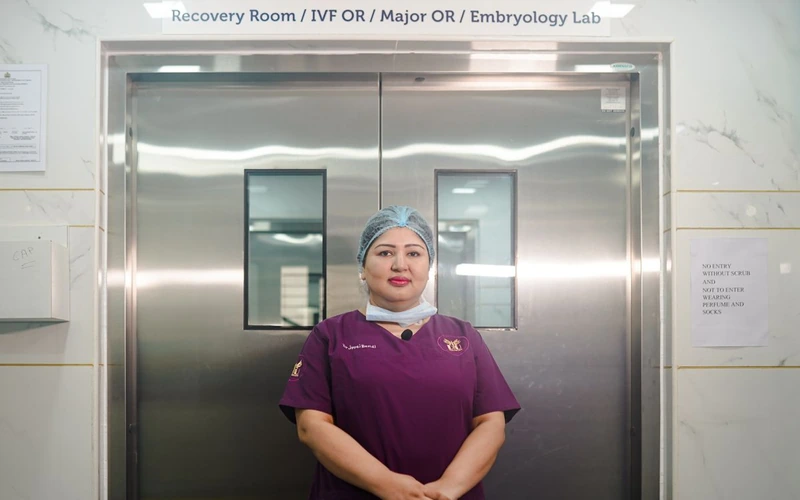
A frozen embryo transfer (FET) is the IVF step in which an embryo frozen in an earlier cycle is thawed and placed into the uterus through the cervix, using a fine soft catheter under ultrasound guidance. There is no egg collection, and in most FET protocols no ovarian stimulation: the two to four weeks beforehand are spent preparing the lining of the womb, either with your own natural cycle or with prescribed oestrogen and progesterone. The transfer itself takes a few minutes, is usually done awake without anaesthetic, and is followed by progesterone support and a pregnancy test around nine to twelve days later.
A frozen embryo transfer, usually shortened to FET, is the part of IVF where an embryo that was frozen in an earlier cycle is thawed and placed into the uterus. There is no egg collection this time, and in most cases no stimulation of the ovaries. Almost the whole cycle is about one thing: getting the lining of the womb ready, and timing the embryo to arrive when that lining is at its most receptive.
That makes an FET a quieter, shorter cycle than the one that produced the embryos, and yet it is often the cycle women have the most questions about, because so much of it happens invisibly. Below I go through it in the order you will live it: what is being frozen and why, how a natural cycle differs from a medicated one, what the scans are really looking for, what transfer day feels like, why progesterone matters so much afterwards, when to test, and what can delay or cancel a cycle. You will notice there are no figures about outcomes anywhere on this page. Those belong in a consultation, with your own age, history and embryo report in front of us, not in a general article.
What Is a Frozen Embryo Transfer (FET)?
A frozen embryo transfer is a short treatment cycle in which a previously frozen embryo is thawed and transferred into the uterus through the cervix, using a fine soft catheter and ultrasound guidance. It is a single outpatient appointment of a few minutes, usually with no anaesthetic, at the end of two to four weeks of preparation and monitoring.
The embryo itself was created earlier, in a stimulated IVF or ICSI cycle, and frozen at one of two stages: cleavage stage, two or three days after fertilisation, or blastocyst stage, five or six days after fertilisation. Blastocyst freezing is now the more common practice in most laboratories. Freezing is done by vitrification, an ultra-rapid method that takes the embryo to the temperature of liquid nitrogen so quickly that ice crystals, which are what used to damage cells in the older slow-freeze methods, do not get the chance to form. Embryos are then stored in liquid nitrogen under continuous monitoring. Laboratories expect the large majority of vitrified embryos to come through a thaw in good condition, although that can never be guaranteed for one particular embryo.
Where the embryos being transferred come from
- Embryos left over after a fresh transfer in an earlier IVF cycle
- A planned freeze-all cycle, where no fresh transfer was intended from the start
- Embryos biopsied for preimplantation genetic testing, which must be frozen while the results come back
- Embryos frozen for fertility preservation before treatment that might affect the ovaries
Egg, sperm and embryo donation are not permitted in Türkiye, so every embryo transferred here is created from the couple's own eggs and sperm. That is worth stating plainly, because it also shapes the paperwork: the consents are signed by the two people whose gametes made the embryos, and they are the only people who can authorise their use.
If the earlier part of the process is still unfamiliar, it may help to read how the stimulation, egg collection and laboratory stages fit together in IVF step by step before reading on, because an FET is essentially the second half of that story, replayed on its own.
One practical point that catches people out: consent forms and storage periods are governed by national law and by the clinic's own paperwork, and they expire. Both partners usually have to sign for the use of the embryos. It is worth confirming that your consents and storage are current before you start planning dates, not in the week of the transfer.
Fresh or Frozen: Why Frozen Transfers Are So Often Chosen Now
The short answer is that freezing became reliable, and once it did, it stopped being necessary to do everything in one go. Separating the stimulation from the transfer means each half of the treatment can be done in the conditions that suit it, rather than compromising both to fit them into the same two weeks.
In a fresh cycle, the transfer happens a few days after egg collection, in a body that has just been through ovarian stimulation. Hormone levels are high and unphysiological, the ovaries are enlarged, and the lining has been developing under those same conditions. For some women none of that matters. For others it matters a great deal, and the cycle is converted to a freeze-all. Common reasons a doctor will advise freezing everything and transferring later include:
- A risk of ovarian hyperstimulation syndrome. Avoiding a pregnancy in the same cycle avoids the hormonal stimulus that makes OHSS worse and more prolonged
- A rise in progesterone before egg collection, which can shift the lining out of step with the embryo
- A lining that is thin, fluid-filled or otherwise not ready on the day it needs to be
- Preimplantation genetic testing, where results are not available for days or weeks
- Unexpected bleeding, infection or illness around the time of egg collection
- Practical and personal reasons: surgery, travel, work that cannot be moved, or simply needing some weeks between a demanding stimulation cycle and the next step
There is also a subtler argument, and it is the one most often discussed in units now: a frozen cycle lets the embryo meet a lining that was grown either by your own natural cycle or by a dose of hormone chosen for that purpose alone. That is a question of physiology rather than of marketing, and it is still debated in the literature. A fresh transfer remains entirely appropriate for many women, particularly when the stimulation has been gentle and everything on the day looks as it should. The decision is made case by case, on your response to stimulation, your hormone levels, the appearance of the lining, the number and stage of embryos, and your own circumstances.
Before the Cycle Starts: Checks, Consents and Planning
An FET cycle usually begins with a planning consultation rather than a prescription, because a handful of things are much easier to sort out beforehand than mid-cycle. The point of this appointment is to confirm that the uterus is a good place to put an embryo, that the paperwork is valid, and that the calendar works.
What is typically reviewed
- The embryo report: how many embryos are stored, at what stage, how they were graded, whether any were tested, and in which order they would be thawed
- The cavity of the uterus: a transvaginal scan, and where there is any doubt a saline infusion scan or hysteroscopy, to look for polyps, fibroids distorting the cavity, adhesions or retained tissue
- Hormonal and general health: thyroid function, prolactin where relevant, vitamin D, blood pressure, weight, smoking and alcohol, and a review of any regular medication for pregnancy safety
- Screening and immunity: infectious screening that is still in date, rubella immunity, and cervical screening up to date
- Folic acid, started before the transfer rather than after a positive test
- The transfer plan itself: natural or medicated cycle, how many embryos, and the dates
If a scan shows something inside the cavity, the usual advice is to deal with it before the transfer rather than transfer around it. A uterine polyp can usually be removed hysteroscopically as a day case, with the transfer deferred by a cycle or two. The same logic applies to a hydrosalpinx, a blocked and fluid-filled tube, which is normally treated surgically before an embryo is transferred. These delays are frustrating, but a cycle postponed costs you weeks, whereas transferring into a cavity that was not ready can cost you an embryo.
This is also the right moment to settle how many embryos will be transferred. In most situations the recommendation is a single embryo, because transferring two does not simply give you two chances. It creates a real possibility of twins, and a twin pregnancy carries higher risks of preterm birth, growth problems, high blood pressure in pregnancy and caesarean delivery for both mother and babies. If you have a strong view either way, raise it here, not on transfer day.
Natural Cycle FET vs Medicated (Hormone Replacement) FET
Both are standard, both are used worldwide, and the difference between them is simply this: in a natural cycle the lining is grown by your own ovulation, and in a medicated cycle it is grown by prescribed oestrogen while ovulation is deliberately left out. Everything else, the thawing, the transfer, the waiting, is the same.
Natural cycle and modified natural cycle FET
Here your own cycle does the work. You are scanned around the middle of the cycle to watch a follicle grow and the lining thicken, and you may be asked to use urine LH tests at home. Ovulation is identified either from the LH surge, from the scan, or by giving a trigger injection once the follicle is mature; when a trigger is used it is called a modified natural cycle. The transfer is then timed from ovulation, with a blastocyst usually going back around five to seven days later, matching where the embryo would have been had it travelled down the tube itself. Most units still add progesterone afterwards to support the second half of the cycle, even though the ovary is producing its own.
The advantages are fewer medications, fewer injections, and the presence of a corpus luteum, the structure left behind after ovulation, which produces not only progesterone but a range of other hormones. The trade-offs are that you need reasonably predictable ovulatory cycles, that monitoring is dictated by your body rather than the clinic diary, including at weekends, and that dates cannot be fixed far in advance.
Medicated, programmed or hormone replacement FET
Here oestrogen is given from the start of the cycle, as tablets, patches or vaginal preparations, sometimes preceded by a down-regulation injection to keep your own ovaries quiet. No ovulation is expected. After roughly ten to fourteen days you are scanned, and when the lining is satisfactory progesterone is started. The transfer is scheduled a set number of days after that first progesterone dose, according to the stage of the embryo. Because the hormones are all coming from outside, the timetable is predictable and can be planned weeks ahead, which is why this approach suits irregular cycles, absent ovulation, women travelling for treatment, and busy clinic schedules.
The trade-offs are more medication, more side effects, and the need for real discipline: in a programmed cycle there is no corpus luteum to fall back on, so missing doses genuinely matters, and the support has to continue until the placenta can take over. There is also a recognised association between programmed cycles and a somewhat greater chance of raised blood pressure in pregnancy compared with cycles that have a natural corpus luteum. It is one of the reasons a number of units now prefer a natural or modified natural cycle whenever the patient's own cycle makes it feasible.
A third option: mild stimulation
If you do not ovulate reliably, because of polycystic ovary syndrome, for example, or hypothalamic suppression, a lightly stimulated cycle using an oral agent such as letrozole or a low dose of injectable gonadotrophin can be used to produce one follicle, and therefore one corpus luteum, before the transfer. It is a middle path: the predictability of a drug-supported cycle with some of the physiology of a natural one. This is the one exception to the general rule that a frozen transfer does not involve stimulating the ovaries, and it is worth understanding the difference in scale. The aim here is a single follicle, with a dose far below anything used to collect eggs, so the ovaries are never pushed in the way they are in an egg-collection cycle.
There is no single right answer. The choice is made from how regular your cycles are, whether you ovulate, what happened in any previous cycle, your medical history, how far you have to travel, and how much flexibility your life allows.
How the Lining Is Prepared and Monitored
The lining is assessed with transvaginal ultrasound, sometimes alongside blood tests for oestradiol and progesterone. Two things are being looked at: how thick the endometrium is, and what it looks like. A receptive lining is usually described as trilaminar, a three-line appearance on the scan that reflects orderly growth under oestrogen.
Most units look for a thickness of roughly seven millimetres or more before adding progesterone, although thresholds vary between clinics and no single number decides anything on its own. Pattern and overall impression matter as much as the measurement, which is why your doctor may be content with a lining that sounds thin to you, or cautious about one that sounds fine. If you want the background on what the measurements mean across the cycle, I have written about normal endometrial thickness separately.
If the lining is not cooperating
- Give it longer. In a medicated cycle oestrogen can often simply be continued for several more days before progesterone is started
- Change the route or the dose of oestrogen, since vaginal, transdermal and oral preparations are absorbed differently
- Look for a mechanical cause: intrauterine adhesions, scarring after surgery or infection, a polyp, or chronic endometritis, all of which are treatable
- Look for fluid in the cavity, which can appear during oestrogen exposure and usually means postponing rather than proceeding
- Switch approach next time: some women who do not respond well to a programmed cycle build a perfectly good lining in a natural one, and the reverse is also true
Progesterone is the other half of the preparation, and its timing is the part people underestimate. Progesterone converts the oestrogen-primed lining into a receptive one, and it opens a window of implantation that is only a couple of days wide. This is why the clinic is so precise about when you start it and at what time of day, and why the transfer is booked for a specific morning rather than sometime next week. Some units measure a blood progesterone level before transfer and adjust the dose or route if it is low. Tests that claim to map your personal window of receptivity by biopsying the lining are offered in some clinics but are not currently part of routine recommended care, and it is fair to ask what evidence supports any add-on you are offered.
Timing the Transfer and Thawing the Embryo
The transfer day is counted either from ovulation, in a natural cycle, or from the first dose of progesterone, in a medicated one, and it is matched to the stage at which the embryo was frozen. A blastocyst is replaced at the point in the cycle where a blastocyst would naturally be arriving in the uterus; a cleavage-stage embryo goes back correspondingly earlier, and is sometimes cultured in the laboratory for a day or two after thawing before it is transferred.
The thaw itself usually happens on the morning of the transfer. The embryologist warms the embryo, removes the cryoprotectant solutions in stages, and then watches it for a short period to see that it re-expands and that its cells look intact. Most clinics will telephone you, or tell you when you arrive, how the embryo looks. If the first embryo does not survive the thaw, and you have others stored, the laboratory will normally thaw the next one in the agreed order and the transfer goes ahead the same day.
It is better to know in advance that a thaw can fail. It is uncommon with vitrified embryos, but it happens, and if there is no suitable embryo to transfer the appointment is cancelled. That is a difficult call to receive. Ask your clinic beforehand how they would handle it, in what order your embryos would be used, and whether anyone can be with you that morning.
You may also be offered assisted hatching, where a small opening is made in the embryo's outer shell, or a transfer medium containing hyaluronan, sometimes marketed as embryo glue. These are laboratory techniques with varying levels of supporting evidence. They are reasonable to discuss and reasonable to decline.
Transfer Day: What Actually Happens, and Does It Hurt?
For most women the transfer is uncomfortable rather than painful, and the comparison people reach for afterwards is a cervical screening test or a smear. It takes a few minutes, you are awake, and no anaesthetic is normally needed. You walk in and you walk out.
What happens, in order:
- You are asked to arrive with a moderately full bladder. This is not an unkindness: a full bladder straightens the angle between cervix and uterus and gives a clearer ultrasound picture through the abdomen
- Your identity and the embryo's identity are checked and double-checked, usually out loud, by the clinical and laboratory staff
- You lie as you would for an examination. A speculum is placed, and the cervix is gently cleaned with culture medium or saline
- A fine, soft catheter is passed through the cervical canal into the uterine cavity while the ultrasound probe is held on your abdomen, so your doctor can see exactly where the tip is
- The embryologist brings the loaded catheter at that moment. The embryo, in a tiny volume of fluid, is released in the upper part of the cavity. On the screen you may see a small flash of brightness
- The catheter is withdrawn and handed straight back to the laboratory, which checks under the microscope that the embryo has in fact left it
- The speculum comes out and you are usually left to rest for a short while before going home
Occasionally the cervix is difficult to negotiate, because of its angle, previous surgery or scarring. Your doctor may use a firmer guide, a different catheter, or gentle traction on the cervix, and this can cause a cramp. If a previous transfer or smear was very painful, or if examinations are difficult for you for any reason, say so when the cycle is planned rather than on the day. A trial transfer at the planning stage, a different catheter, or in selected cases light sedation can all be arranged in advance.
Afterwards, mild cramping and a little spotting from the cervix are common and do not mean anything has gone wrong. Prolonged bed rest is not recommended; lying still for hours does not help implantation and does not make it any likelier. Normal walking, normal work, normal daily life are all fine. What I would avoid in the days afterwards is very strenuous exercise, heavy lifting, saunas, hot tubs and hot baths. Paracetamol is usually acceptable for cramps; ask your own clinic before taking anti-inflammatory painkillers.
Progesterone Support After the Transfer
Progesterone support is given after essentially every frozen transfer, and in a medicated cycle it is not optional at any point. The lining cannot stay receptive, and an early pregnancy cannot be maintained, without it. In a programmed cycle your oestrogen continues too, because there is no ovary doing that job.
It can be given in several ways, and the route is chosen for tolerance and practicality as much as anything: vaginal pessaries, capsules or gel, intramuscular injections into the buttock, subcutaneous injections, or an oral preparation such as dydrogesterone. Some clinics combine routes. Side effects are the usual complaints of progesterone, meaning bloating, breast tenderness, drowsiness, mood changes, and with vaginal preparations a thick discharge or local irritation; with injections, soreness and lumpiness at the site. The second half of a luteal phase feels much like this naturally, which is covered in more detail in my article on the luteal phase of the cycle.
Practical points that matter more than people expect
- Keep to the times you were given. Timing relative to the transfer is part of the treatment, not a convenience
- If you miss a dose, take it as soon as you remember and contact your clinic for advice; do not double up on your own initiative
- Do not stop because you start bleeding. Bleeding on progesterone support is not in itself a reason to stop, and stopping can make matters worse. Ring the clinic first
- Do not stop because you feel pregnant, or because you do not. Neither feeling tells you anything about the result, and stopping early can do harm. Ring the clinic before changing anything
- Expect it to continue after a positive test. Support is usually carried on into the first trimester, commonly until somewhere between eight and twelve weeks, when the placenta is producing enough of its own
You may also hear about low-dose aspirin, heparin, steroids, intralipids, immune therapies or growth hormone being added around a transfer. Some of these have a place in specific, diagnosed conditions. Most do not have good evidence as general additions for everybody, and some are not free of risk. Ask what the specific indication in your case is, and what the evidence is, before agreeing.
The Two-Week Wait and When to Test
Test on the date your clinic gives you, which after a blastocyst transfer is usually around nine to twelve days afterwards, and prefer the blood test. A blood hCG measurement is more sensitive and more informative than a urine test, and your clinic will often repeat it about forty-eight hours later to see how the level is changing, which tells more than any single value.
Home urine tests taken early are the main source of unnecessary distress in these two weeks. Too early, they can be negative when a pregnancy is in fact establishing. One small mercy of frozen transfers is that most do not involve an hCG trigger injection, so the false positives that can occur in fresh cycles are much less of a problem, but that does not make a test five days after transfer meaningful.
Symptoms will not tell you either. Cramping, sore breasts, tiredness, nausea, bloating, a feeling that your period is coming, a feeling that it is not: all of these are produced by progesterone, whether or not there is a pregnancy, and that is precisely why this fortnight is so hard to read. Light spotting is common and is not a reliable sign in either direction, which I explain further in my article on implantation bleeding. The honest position, and I say this plainly to patients, is that there is nothing you can read from your body during these days, and no amount of searching will change the result.
What helps, practically: plan the fortnight before it starts, keep working if work distracts you and take time off if it does not, stay off the forums if they frighten you, and agree with your partner or a friend how and when you will hear the result. Keep taking your medication exactly as prescribed. If the test is positive, you will be given a date for an early ultrasound, usually two to three weeks later, to confirm the location and the heartbeat. If it is negative, stop the medication only when your clinic tells you to, and book a follow-up. There is usually something to learn for the next cycle, and the remaining embryos are unaffected.
What Can Delay or Cancel an FET Cycle
A frozen cycle can be stopped at several points, and the single most important thing to understand is that if it is stopped before the thaw, your embryos are still frozen and nothing has been lost except time. Cancellation is not failure; it is the system working.
Reasons a cycle is postponed or abandoned
- The lining does not develop adequately despite extended oestrogen, or does not have a receptive pattern
- Fluid appears in the cavity, or a polyp, fibroid or adhesion is seen that was not there or not apparent before
- Ovulation happens too early, or a progesterone rise is detected before the planned start, in a natural-cycle plan
- The LH surge is missed or cannot be identified, so the transfer cannot be timed safely
- A cyst or a persistent follicle is producing hormone and distorting the cycle
- Chronic endometritis or another infection is diagnosed and needs treating first
- Illness, fever, a significant infection or surgery intervenes, or a new medical problem needs attention first
- Thyroid function or another hormonal abnormality is found and needs correcting
- Consents or storage paperwork have lapsed, or a signature is missing
- A spontaneous pregnancy is discovered, which does happen
- No embryo survives the thaw, or a laboratory or storage issue arises
If your cycle is cancelled, ask two questions before you leave: what specifically was the reason, and what will be done differently next time. A cancelled programmed cycle may become a natural one. A thin lining may lead to a hysteroscopy. A missed surge may lead to closer monitoring. The answer should be concrete.
Risks, Side Effects and Aftercare
The transfer itself is a low-risk outpatient procedure. Most of what is worth knowing about risk in an FET relates to the pregnancy that may follow, not to the few minutes in the procedure room. Ovarian hyperstimulation syndrome, which is the risk people most associate with IVF, is essentially not a feature of frozen cycles, because the ovaries are either not stimulated at all or, in a lightly stimulated cycle, stimulated only enough to produce a single follicle, which carries negligible risk.
From the procedure
- Cramping for a few hours, and light spotting from the cervix
- Pelvic infection, which is uncommon
- Side effects of oestrogen and progesterone, which are the commonest complaints of all
From the pregnancy
- Multiple pregnancy if more than one embryo is transferred, with its higher risks of preterm birth and complications for mother and babies, which is the reason single embryo transfer is usually advised
- Ectopic pregnancy, which remains possible even though the embryo is placed directly into the uterus, because an embryo can migrate into a tube. This is why new, one-sided pain after a positive test is always taken seriously
- Miscarriage, at a risk that relates mainly to age and to the embryo itself rather than to the fact of freezing
- Raised blood pressure and pre-eclampsia, reported somewhat more often after programmed cycles than after cycles with a natural corpus luteum, and a reason your blood pressure will be watched in pregnancy
- Larger birth weight, reported more often after frozen than fresh transfers, which is relevant to how late pregnancy and birth are managed
- Blood clots, since oestrogen treatment and early pregnancy each slightly increase the risk of a clot in a leg vein or in the lungs, and in a programmed cycle the two overlap
When to seek medical help straight away
- Severe or one-sided pelvic pain, particularly with a positive pregnancy test
- Heavy bleeding, meaning soaking a pad or passing clots
- Pain at the tip of the shoulder, faintness, dizziness or collapse
- Pain, swelling, redness or tenderness in one calf or thigh
- Chest pain, breathlessness, or coughing up blood
- Fever, or offensive vaginal discharge
- Persistent vomiting, severe bloating, or difficulty passing urine
The two clot-related items deserve a word of explanation, because they are easy to dismiss as a pulled muscle or a stitch. Oestrogen treatment and early pregnancy both slightly increase the risk of a blood clot, which is why a painful or swollen calf, or chest pain, breathlessness or coughing up blood, needs same-day assessment rather than waiting to see whether it settles. Say that you are on oestrogen and may be pregnant when you ring or attend, because it changes how you will be assessed. If you have had a clot before, or there is a strong family history, tell your doctor at the planning stage rather than once the cycle has started.
None of these is common, and most women go through an FET with nothing more than cramps and the side effects of their medication. But you should know what is urgent, and you should have a number to call out of hours before transfer day rather than searching for one at two in the morning.
Questions Worth Asking, and Where This Fits in Your Plan
A frozen embryo transfer is usually a lighter cycle to go through than the stimulated cycle that produced the embryos, and one of the more detailed to plan. Most of the decisions have already been made by the time you arrive for the transfer, which is exactly why the planning consultation is where your questions belong.
Reasonable things to ask your own team
- How many embryos do I have stored, at what stage, and in what order will they be used?
- Are you recommending a natural or a medicated cycle for me, and why that one?
- Does my uterine cavity need assessing or treating before we transfer?
- How many embryos do you advise transferring, and what is your reasoning?
- Which progesterone will I use, from when, and until when if the test is positive?
- What would make you cancel this cycle, and what happens to my embryos then?
- Are any of the extras being offered to me supported by evidence in my particular situation?
- Do I have any personal or family history of blood clots that changes how this cycle should be run?
- Who do I call, and on what number, if something worries me at the weekend?
If you are at the beginning of all this rather than in the middle of it, the broader picture of assessment, treatment options and what each step involves is set out on my page about IVF treatment. And if you are deciding between approaches, bring your previous cycle notes, your embryo report and your scan results to the appointment. A plan made with those in front of us will be specific to you, which is more than any article can be.
References
The following current and independent health sources were used in preparing this article.
- NHS. IVF
- NICE. Fertility problems: assessment and treatment (CG156)
- ACOG. Women's Health
- MedlinePlus. Infertility