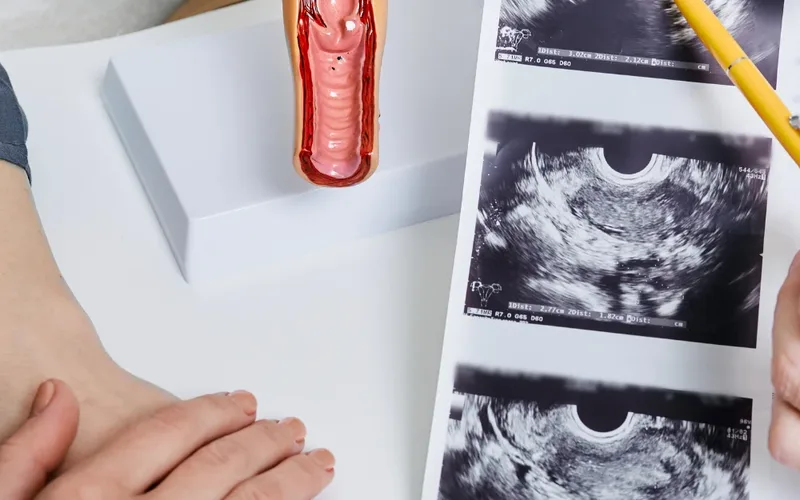
Pelvic organ prolapse happens when the muscles, ligaments and connective tissue supporting the pelvic organs weaken, so the bladder, rectum, uterus or the top of the vagina descends into the vaginal canal. The most characteristic symptom is a feeling of heaviness, dragging or a bulge low in the vagina, often worse by the end of the day, sometimes with difficulty emptying the bladder or bowel. Mild prolapse is usually managed with supervised pelvic floor muscle training and everyday measures; a vaginal pessary or surgery is considered when symptoms persist and interfere with daily life.
If you have been told you have a prolapse, or you have noticed something that was not there before - a heaviness low down, a dragging sensation by the end of the day, soft tissue closer to the vaginal opening than it used to be - it is natural to assume the worst. So let me begin with the reassurance that matters most. Pelvic organ prolapse is a problem of support. It is not a growth, it is not a cancer, and it is not a sign that your body has failed. It is common, it is well understood, and in most women it is managed without an operation.
What follows is the explanation I give in the consulting room, written out in full: what prolapse actually means, which organ is involved in each type, which symptoms genuinely come from prolapse and which do not, how stages 1 to 4 are measured and why the stage matters less than you would expect, and what the real treatment options are - pelvic floor muscle training, a vaginal pessary, and surgery - including how the decision between them is made. At the end you will find clear guidance on the small number of situations that need prompt medical attention.
What Prolapse Means, in Plain Words
Prolapse means that something has slipped down from where it should sit. In gynaecology, pelvic organ prolapse describes the downward movement of one or more pelvic organs - the bladder, the rectum, the uterus, or the top of the vagina in a woman who has had a hysterectomy - into the vaginal canal, and sometimes as far as or beyond the vaginal opening.
It helps to picture the pelvic floor as a hammock of muscle slung between the pubic bone at the front and the tailbone at the back, with the urethra, vagina and rectum passing through it. The pelvic organs rest on that hammock, and they are also suspended from above by ligaments and sheets of connective tissue that anchor the cervix and the vaginal walls to the side walls of the pelvis. Support therefore comes from two directions at once: muscle holding from below, ligament and fascia holding from above. When those fibres stretch, tear or thin out, the organ they were holding is no longer fully supported, and gravity and abdominal pressure do the rest.
That is the whole mechanism, and it explains two things women often find puzzling. It explains why prolapse typically feels worse at the end of a long day on your feet and better after lying down, because the load on a weakened support system varies through the day. And it explains why prolapse is talked about as though it were several different conditions when it is really one: a cystocele, a rectocele, uterine prolapse and vaginal vault prolapse are the same failure of support happening in different parts of the same structure.
You will also come across the terms pelvic floor prolapse, vaginal prolapse, dropped bladder and dropped womb. These are everyday names for the same thing. Prolapse is genuinely common: when gynaecologists examine women who have given birth, some degree of descent is found in a large proportion of them, yet only a minority have symptoms that trouble them. This matters, because it means a prolapse discovered incidentally during a smear or a routine check is not in itself a reason to be treated. What is treated is the symptom, not the finding on the examination couch.
The Types of Prolapse: Which Organ Has Descended
Prolapse is named after the structure that has come down, and the vagina is described as having three compartments: the front wall, the back wall and the top. Knowing which compartment is involved tells you which symptoms to expect and which treatments are worth considering.
- Cystocele - front (anterior) wall. The bladder presses into the front wall of the vagina. This is the commonest type. Typical symptoms are a bulge felt towards the front, a sense that the bladder has not emptied fully, a slow or stop-start stream, and sometimes needing to pass urine again a few minutes later.
- Rectocele - back (posterior) wall. The rectum bulges forwards into the back wall of the vagina. Typical symptoms are a bulge felt towards the back passage and difficulty emptying the bowel: a feeling of obstruction, and the need to press on the back wall of the vagina or on the skin between the vagina and the anus to finish a bowel movement. This manoeuvre is called splinting, and it is very commonly discovered by women themselves and never mentioned to a doctor.
- Uterine prolapse - the top (apex). The cervix and uterus descend down the vaginal canal. This is usually felt as heaviness, dragging or a firm lump low in the vagina, which in more advanced cases becomes visible or easily felt at the entrance.
- Vaginal vault prolapse - the top, after hysterectomy. When the uterus has been removed, the top of the vagina itself can descend, because the same ligaments that supported the cervix also support the vaginal apex. This is why having had a hysterectomy does not make prolapse impossible later on.
- Enterocele. A loop of small bowel pushes into the upper vagina. It almost always accompanies weakness at the apex rather than occurring on its own.
- Urethrocele. Descent of the urethra beneath the lower front wall, usually found together with a cystocele.
In practice, prolapse in more than one compartment is the rule rather than the exception. The supporting tissues are continuous, so whatever weakened one part has usually acted on its neighbours too. A woman who notices a front-wall bulge frequently has some apical descent as well, and the apex is easy to underestimate because the obvious bulge draws the eye.
That is not a technicality. Support at the top of the vagina is what keeps the front and back walls in position, so a repair that addresses only the visible wall and leaves an unsupported apex is one of the recognised reasons prolapse comes back. A large part of what a gynaecologist is working out during the examination is exactly this: where the real defect sits.
One further point about naming. A heavy, dragging pressure in the pelvis is not specific to prolapse. A bulky uterus means that fibroids can produce very similar pressure symptoms, and the two can easily coexist. Distinguishing them is part of the assessment rather than something you can decide for yourself from symptoms alone.
Pelvic Organ Prolapse Symptoms
The symptom that points most directly to prolapse is awareness of a bulge: a feeling of something coming down, of sitting on a small ball, or of fullness and dragging low in the vagina. If that sensation is present, worsens with standing, walking or straining, and settles when you lie down, prolapse is very likely to be the explanation.
The daily pattern is characteristic and worth describing to your doctor. Most women feel little or nothing on waking, notice heaviness building through the afternoon, and feel it most after a long period upright, after lifting, after exercise, or at the end of a working day. Many also report that the bulge is more noticeable before a period or when they are constipated. A symptom that is constant and completely unchanged by position is less likely to be coming from prolapse alone.
Bladder symptoms
Front-wall prolapse displaces and kinks the base of the bladder, so the complaints are usually about emptying rather than leaking: a hesitant or interrupted stream, a feeling of residual urine, needing to empty twice, or having to change position on the toilet. Some women find they have to reduce the bulge with a finger in order to pass urine properly. Stress leakage with coughing or exercise can occur alongside prolapse, but it is a separate problem with its own treatment. Occasionally leakage only appears after a prolapse has been corrected, because the prolapse had been obstructing the urethra and masking it. Urine that never empties completely can also lead to repeated urinary infections.
Bowel symptoms
Back-wall prolapse tends to cause obstructed emptying: straining despite a soft stool, incomplete evacuation, a sense that stool is trapped just inside, and splinting with a finger to complete the movement. Constipation and prolapse feed each other, which is why bowel management is a genuine part of treatment rather than an afterthought.
Sexual symptoms and discomfort
Women may notice reduced sensation, an awareness of laxity, or anxiety about how things look or feel to a partner, and some avoid intercourse altogether because of the bulge. These are legitimate clinical concerns, not embarrassing extras. They should be raised, because they often change which treatment is appropriate - several options are chosen or ruled out specifically on the basis of sexual activity.
Severe or sharp pelvic pain, on the other hand, is not a typical feature of prolapse. Prolapse causes heaviness, pressure and ache, not acute pain. If pain is your dominant symptom, it is worth looking at the other causes of pelvic pain in women and having those considered alongside the prolapse. The same applies to bleeding: prolapse itself does not cause bleeding unless exposed tissue has become dry and ulcerated, so any new or unexplained bleeding needs its own assessment regardless of what the prolapse is doing.
Mild Pelvic Organ Prolapse: What It Means and What To Do
Mild prolapse means the descent is small - stage 1, or early stage 2 - with the lowest point still comfortably inside the vagina, and it is very often found during a routine smear or a postnatal check in a woman who had no complaint at all. In that situation the correct treatment is usually no treatment, beyond looking after the pelvic floor.
When mild prolapse does cause symptoms, they are typically intermittent: slight heaviness at the end of the day, a feeling of looseness, an occasional sense of something low down when you are tired, premenstrual or constipated, which has disappeared again by morning. Many women describe first noticing it in the shower or while washing, feeling soft tissue nearer the opening than before. What mild prolapse is not is dangerous. It does not threaten the kidneys, it does not turn into anything else, and it does not need urgent intervention.
Nor does mild prolapse inevitably get worse. It can remain unchanged for decades. It fluctuates with weight, constipation, coughing and activity, so a bad few weeks does not mean progression. In the months after childbirth it commonly improves on its own as tissues recover and as oestrogen levels return to normal once breastfeeding ends - which is one good reason not to rush into decisions in the first year after a birth.
Mild prolapse also does not usually need a schedule of follow-up appointments. What is reasonable is to be seen again if the sensation becomes constant rather than end-of-day, if bladder or bowel emptying changes, or if you can feel tissue at the opening when you could not before. Those are the changes that alter the plan. A slightly worse fortnight after a chest infection or a spell of constipation is not.
The plan for mild prolapse is pelvic floor muscle training plus attention to the everyday factors that load the pelvic floor - both are set out in detail further down this page. If symptoms persist despite that, or if they are limiting what you can do, the next step to discuss is a pessary, not surgery. Surgery is reserved for prolapse that is both symptomatic and not adequately helped by these measures.
Stages 1 to 4: How Prolapse Is Measured
Prolapse is staged by how far the lowest point of the descent reaches in relation to the hymenal ring - the level of the vaginal opening - while you are straining. The system most gynaecologists use is called the POP-Q. It is measured on examination; it cannot be worked out from symptoms, and it is not something you can stage yourself.
- Stage 0 - no descent is demonstrated; the supports sit in their normal position.
- Stage 1 - the leading edge stays more than 1 cm above the level of the vaginal opening. Usually symptom-free.
- Stage 2 - the leading edge reaches within 1 cm above or below the opening, so at maximum straining it is essentially at the entrance. This is the stage at which women most often first notice a bulge.
- Stage 3 - the leading edge protrudes more than 1 cm beyond the opening, but the vagina is not completely turned inside out.
- Stage 4 - complete eversion, with the vagina and the uterus or vault essentially fully outside. This is sometimes called procidentia.
Some clinicians still use the older Baden-Walker grading, which runs from grade 0 to grade 4 - grade 0 meaning no prolapse is demonstrated - and describes much the same thing in less detail. Each compartment is staged separately, so it is perfectly normal to be told you have, for example, a stage 2 cystocele with stage 1 uterine descent. Measurements are taken while you strain, and often with you standing, because a prolapse that looks modest while you are lying down can descend considerably once you are upright.
Here is the part that surprises people. The stage correlates poorly with how much a prolapse bothers you. Women with stage 2 can be very symptomatic, and women with stage 3 can be relatively untroubled. The threshold at which a bulge begins to be felt is roughly the level of the vaginal opening, which is why symptoms tend to appear around stage 2, but beyond that point there is no reliable relationship between the number and the experience.
This is why your treatment is chosen on the basis of your symptoms and what they prevent you doing, with the stage as supporting information - and not the other way round. If you leave a clinic with a stage number and no discussion of how much it troubles you, the most important half of the conversation has not happened yet.
Why the Pelvic Floor Gives Way: Causes and Risk Factors
Prolapse develops when the load on the pelvic supports exceeds what those supports can carry, either because the load is high or because the tissue is weak - usually a combination of both, acting over many years.
Childbirth is the single largest contributor. Vaginal delivery stretches the pelvic floor muscles and can detach part of the levator muscle from the pubic bone, and the risk is greater with instrumental delivery, particularly forceps, with a prolonged second stage, and with a larger baby. Each additional vaginal birth adds to the risk. Caesarean delivery reduces it but does not abolish it, because pregnancy itself loads the pelvic floor - which is why prolapse is still seen in women who have only had caesareans, and occasionally in women who have never been pregnant at all.
The menopause is the second major factor. Oestrogen supports the collagen and elastin content of the vaginal wall and the tissue around it; as levels fall, that tissue becomes thinner and less resilient, and a prolapse that had been stable and silent for years can become symptomatic within a couple of them. Ageing of muscle contributes independently of hormones.
The third group is anything that repeatedly raises pressure inside the abdomen: chronic constipation and straining at stool, a chronic cough from smoking or lung disease, regular heavy lifting at work or in training, and a higher body weight, which raises the resting load on the pelvic floor continuously rather than in spikes. These are the factors that can actually be changed, which is exactly why they take up so much space in treatment.
Finally, tissue quality itself varies between women. Prolapse clusters in families, and it is more common and appears earlier in women with inherited connective tissue disorders such as Marfan or Ehlers-Danlos syndrome. Previous pelvic surgery, including hysterectomy, alters the support of the vaginal apex and is a recognised risk factor for prolapse later. Occasionally a large pelvic mass or significant chronic lung disease turns out to be the dominant cause in an individual woman, which is one reason the assessment looks beyond the pelvis.
How Prolapse Is Diagnosed
Prolapse is diagnosed clinically, from your history and a pelvic examination. No scan and no blood test is needed to make the diagnosis. Investigations are used to answer specific additional questions, not to confirm what the examination has already shown.
The history covers what you feel and when, bladder emptying and leakage, bowel emptying and straining, sexual function, obstetric history, previous surgery, menopausal status, cough, lifting - and, crucially, how much all of this interferes with your life. Many clinics use a short symptom questionnaire, and sometimes a bladder diary kept over a few days, because these capture patterns that are very hard to recall accurately in a ten-minute appointment.
The examination is usually done with you lying on your back, often using a single-bladed Sims speculum so that each vaginal wall can be inspected separately while the other is held out of the way. You will be asked to cough or bear down, and frequently to repeat this standing, which is the position in which the true extent of the descent becomes clear. The cervix and vaginal walls are checked for thinning, ulceration or abnormal discharge. Your ability to contract the pelvic floor is assessed too, because that determines whether muscle training is likely to help you and how it should be taught.
Beyond that, testing is selective. A bladder scan after you pass urine shows whether you are emptying completely. A urine sample is sent if infection is suspected. Urodynamic studies are considered when incontinence is a significant part of the picture, or before continence surgery, rather than routinely. A pelvic ultrasound is not required to diagnose prolapse, but it is often arranged to look for another explanation for pressure symptoms or for abnormal bleeding. If anything about the cervix or the lining of the uterus raises a question, that is investigated on its own merits and not folded into the prolapse diagnosis.
An examination for prolapse is brief and should not be painful. If you are anxious about it, say so at the start. The position, the size of the speculum and the pace can all be adjusted, a chaperone can be present, and nothing has to be completed in a single visit.
Pelvic Floor Exercises: The First-Line Treatment
For prolapse at stage 1 or stage 2, a supervised programme of pelvic floor muscle training is the recommended first treatment, and NICE guidance advises a programme of at least 16 weeks before judging the result. The word supervised is in that recommendation for a reason: being taught by a pelvic health physiotherapist who checks that you are contracting the right muscle in the right way is what guidelines specify, rather than a leaflet handed over at the end of an appointment.
Be clear about what these exercises do and do not do. They will not pull a descended organ back into its original anatomical position. What they do is strengthen the muscular floor underneath it, improve the timing of the contraction so that the floor tightens before you cough or lift rather than after, and in many women reduce the sensation of bulge along with the bladder and bowel symptoms that travel with it. The aim is a pelvic floor that can do its job under load.
How to do a correct contraction
- Sit or lie comfortably. Imagine squeezing to stop yourself passing wind, and at the same time drawing the vaginal and urethral area upwards and inwards.
- Keep breathing normally throughout. Holding your breath, pushing the abdomen outwards or bearing down are the commonest errors and are actively counterproductive.
- Your buttocks, thighs and abdominal wall should stay relaxed. If they are joining in, the effort is too hard - reduce it until only the pelvic floor is working.
- Combine slow and fast work. Hold for up to ten seconds and release fully, then do a set of short, sharp one-second squeezes. Complete relaxation between contractions matters as much as the squeeze itself.
- Three sessions a day, every day, for at least sixteen weeks. Ten slow and ten fast contractions per session is a reasonable target, built up gradually rather than attempted on day one.
- Do not use stopping your urine mid-stream as a regular exercise. It is acceptable once, to identify the muscle, but repeated as training it can interfere with normal bladder emptying.
Once you can reliably find the muscle, the genuinely useful step is to use it during the activities that provoke your symptoms: tightening before and during a cough, a sneeze, standing up from a chair, or lifting a child or a bag of shopping. This habit, sometimes called the knack, is often what produces the practical difference in everyday life rather than the repetitions themselves.
Exercise in general should be modified, not abandoned. There is no need to give up activity because of prolapse, and most women do better by continuing to move - with attention to breathing out through effort rather than bracing against a closed throat when lifting. If high-impact training consistently makes symptoms worse, a physiotherapist can help you adjust load, technique and progression instead of stopping altogether.
Vaginal Pessaries: The Main Non-Surgical Alternative
A pessary is a soft, flexible silicone device placed in the vagina to hold the prolapse up mechanically. It is the main option for women whose symptoms have not been relieved enough by exercises, and for anyone who wants to avoid surgery, postpone it, or simply find out what life feels like with the prolapse supported before committing to an operation.
Several shapes exist because different prolapses need different mechanics. A ring pessary, with or without a support membrane, is the usual first choice and the easiest to manage yourself. A Gellhorn, shelf, donut or cube pessary provides more support and is used for larger or more advanced prolapse, generally in women who are not sexually active, since these are harder to remove and reinsert. Fitting is a matter of trial rather than calculation: the size and shape are chosen in clinic, and it is entirely normal to try more than one before finding the right fit.
A correctly fitted pessary should be unnoticeable. You should not feel it when sitting, walking or passing urine, and it should not come out when you strain or open your bowels. If you can feel it, if it is uncomfortable, or if it makes passing urine harder, it is the wrong size or shape and should be changed rather than endured.
Living with a pessary
Many women are taught to remove, wash and reinsert the device themselves, typically at night or once a week. This gives the most independence and keeps the vaginal tissue healthy. Otherwise it is changed in clinic at intervals agreed with your doctor, commonly every few months. Vaginal oestrogen as a cream or tablet is often prescribed alongside a pessary after the menopause, because supple, well-oestrogenised tissue tolerates a device far better than thin, dry tissue does.
Increased discharge is the commonest nuisance. Some change is expected with a device in place, but discharge that becomes heavy, bloodstained or offensive is not, and neither is new bleeding, new pain, or difficulty passing urine or opening the bowels. Any of these means the pessary should be removed and reviewed rather than left in place. If you are unsure whether what you are seeing is expected, it is worth understanding the different types of vaginal discharge and what each one suggests, and then having it checked.
A pessary does not repair anything. It manages symptoms for as long as it is worn, and it can be used for years, indefinitely, or as a bridge until the time is right for an operation. It is a legitimate long-term treatment in its own right, not a second-best substitute for one.
Everyday Measures That Reduce the Load on Your Pelvic Floor
Whatever else you do, reducing the daily pressure on the pelvic floor is part of the treatment. These measures are not alternatives to the options above; they are what allows those options to work, and what reduces the chance of a repair being undone afterwards.
Constipation is the first target, because straining at stool applies a large downward force over and over again. Adequate fibre and fluid, a regular routine, responding to the urge rather than deferring it, supporting your feet so the knees sit a little above hip level, and above all not straining, will do more than any single other change. If the stool is still hard, a softening laxative is reasonable and your doctor can advise which type suits you; reaching for a stimulant laxative long term is not the answer.
Chronic cough deserves the same attention. Stopping smoking, and having asthma or chronic bronchitis treated properly, removes a repeated pressure spike that no amount of pelvic floor training can fully compensate for.
Weight matters because this load is continuous rather than occasional. Where body weight is high, even a modest reduction lowers the standing pressure on the pelvic floor and often improves symptoms more than women expect. Lifting technique is the other practical change: breathe out as you lift, keep the load close to your body, avoid holding your breath and bracing downwards, and tighten the pelvic floor before the effort rather than halfway through it. Where heavy lifting is unavoidable at work, it is worth a specific conversation about how to share or stage it.
After the menopause, treating vaginal dryness and tissue thinning with low-dose vaginal oestrogen makes a real difference to comfort, to how well a pessary is tolerated, and to the quality of the tissue a surgeon has to work with. It is a local treatment with minimal absorption into the bloodstream and it is often continued long term. Whether it is suitable for you is a conversation to have with your own doctor, particularly if you have a history of hormone-sensitive cancer.
Surgery for Prolapse and How the Decision Is Made
Surgery is considered when prolapse symptoms are genuinely bothersome and conservative measures have not given enough relief - not because of the stage written on a chart. A stage 3 prolapse that does not trouble you does not need an operation. A stage 2 that stops you working, exercising or having a normal sex life may well justify one.
Prolapse operations aim to restore support, and they are chosen according to which compartment has failed.
- Anterior repair, or anterior colporrhaphy. The front vaginal wall is reinforced using the woman's own tissue to support the bladder.
- Posterior repair, or posterior colporrhaphy. The back wall is reinforced to support the rectum, sometimes together with repair of the perineal body.
- Apical suspension with the uterus preserved. The cervix and uterus are resuspended, for example by sacrospinous hysteropexy or a Manchester-type procedure, for women who wish to keep the uterus.
- Vaginal hysterectomy with apical support. Removal of the uterus combined with suspension of the vaginal vault - because removing the uterus by itself provides no support and may leave the apex unsupported.
- Sacrospinous fixation or uterosacral ligament suspension. Vaginal routes for resuspending the vault, often used after a previous hysterectomy.
- Sacrocolpopexy. The vaginal vault is suspended to the ligament overlying the sacrum using a mesh strip, performed abdominally and commonly through a laparoscopic or keyhole approach. It is used mainly for apical and vault prolapse, often in younger or more physically active women, or after a vaginal repair has failed.
- Colpocleisis. The vagina is partly closed off. This is a short, low-stress operation for frail or elderly women with advanced prolapse who do not wish to have vaginal intercourse in the future.
Mesh deserves a direct word, because you will read a great deal about it. Transvaginal mesh for prolapse repair has been suspended or heavily restricted in many countries following serious complications, and it is not a routine option. Mesh used abdominally in sacrocolpopexy is a different operation with a different risk profile and continues to be used in selected cases. If mesh is proposed to you in any form, you are entitled to be told precisely which operation is meant, why it is being recommended over a repair using your own tissue, and what the specific risks are.
What actually goes into the decision
The honest answer is that there is rarely only one acceptable option, and the choice is a shared one. The factors that drive it are: which compartments are involved and whether the apex needs supporting; what your dominant symptom is; whether you have urinary leakage that should be dealt with at the same time or deliberately later; whether you may want a future pregnancy, which generally argues for deferring a definitive repair; whether you are or wish to remain sexually active, which rules some procedures in and others out; whether you have had previous prolapse surgery; the quality of your tissues; your general health and fitness for anaesthesia, which influences the surgical route; and your own priorities, including how you weigh a larger operation now against the possibility of needing another one later.
Recovery after a vaginal repair usually means a day case or one to two nights in hospital, a few weeks of tiredness, and avoiding heavy lifting, straining and intercourse for around six weeks, with a longer restriction on heavy lifting after abdominal procedures. Prolapse can recur after any repair, and that possibility is a standard part of the consent conversation. It is also why the everyday measures described above continue to matter after an operation, rather than stopping on the day you are discharged.
When to Seek Medical Advice, and the Red Flags
Most prolapse is not urgent and can be assessed at a routine appointment. A small number of situations need attention the same day.
Seek urgent medical care if you have
- An inability to pass urine at all, or passing only small amounts with a painful, distended lower abdomen. This is urinary retention and needs immediate attention.
- A prolapse that has come outside and cannot be pushed back in, especially if it is painful, swollen, discoloured or bleeding.
- Raw, ulcerated or bleeding tissue on an exposed prolapse, or bleeding that is heavy or does not stop.
- Fever, feeling generally unwell, loin or back pain, or an offensive discharge, which can indicate infection of the urinary tract or of exposed tissue.
- A pessary that cannot be removed, or that is causing pain, bleeding, offensive discharge, or difficulty passing urine or opening your bowels.
- Any new bleeding after the menopause, whether or not you have a prolapse. It needs investigating on its own account and should never be attributed to prolapse without assessment.
Arrange a non-urgent appointment if you have a persistent sensation of a bulge or heaviness, new difficulty emptying your bladder or bowels, recurrent urinary infections, pain or difficulty with intercourse, or if you can see or feel tissue at the vaginal opening. There is no advantage in waiting until it is worse, and there is no stage at which it is not worth being assessed.
One last thing, said plainly because it may be the most important sentence here. Women commonly live with prolapse symptoms for years before mentioning them, usually out of embarrassment or an assumption that this is simply what happens after childbirth or at a certain age. It is a problem of support, and the options for managing it are discussed openly; you will not be the first person to describe it in any consulting room, and there is a whole spectrum of help between doing nothing at all and having an operation. If something does not feel right, have it looked at - and you can read more on related subjects in our women's health information.
References
The following current and independent health sources were used in preparing this article.